Inception
The Early Dance Group began its activities at Bauska Castle Museum in the summer of 2007. The establishment of a permanent dance group was a well-founded step in implementing the “living museum” concept, aiming to gradually develop the museum into a center for the study and practical exploration of Renaissance and Mannerist culture and daily life. This includes research, reconstruction, and practical training in historical dance.
Group leader
The artistic director of the dance group is Ilona Ozola, a specialist at Bauska Castle Museum. She conducts research on the daily life culture and dance history of the Renaissance and Mannerist periods, analyzes historical dance notation, creates dance reconstructions and interpretations based on 16th–17th century court dance manuals, and is the author of the group’s choreographed dance programs.
Participants and Costumes
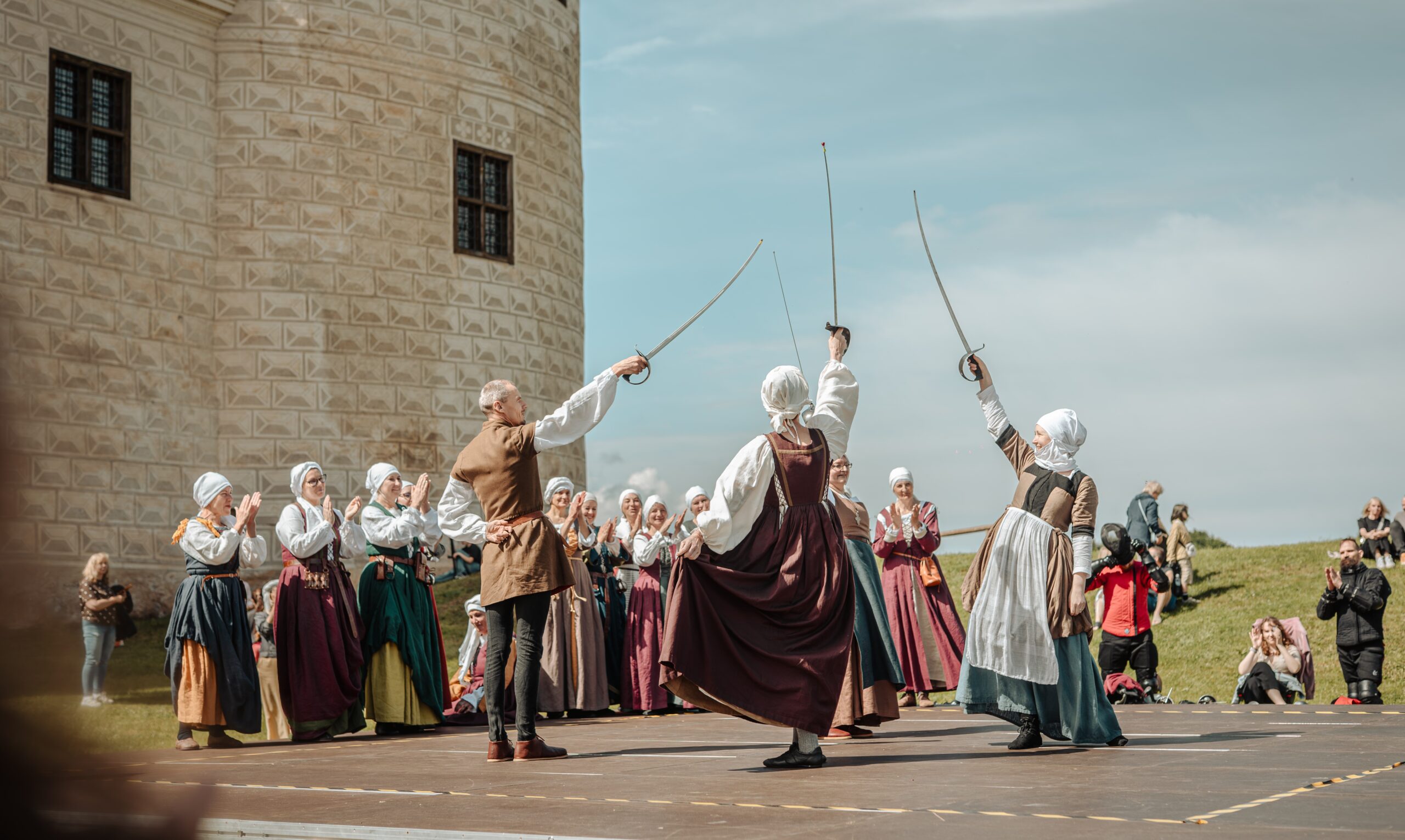
The group consists of individuals from various professions interested in cultural history, as well as in the daily life and court culture during the period of Bauska Castle. Each participant wears a distinct costume representing simple townspeople, created using images from period engravings and paintings. All costumes are made using patterns selected from historical tailor manuals. Some participants also wear courtier costumes, modeled on ceremonial attire depicted in portraits of historical figures related by kinship to the Kettler family, the Dukes of Courland and Semigallia.
Concerts and Dance Programs
The group “Galms” performs at concerts and events at Bauska Castle — during the Night of Museums, fencing tournaments, the opening days of the tourist season, Early Music festivals, and other events. They have also performed elsewhere in Latvia, Lithuania, and the Czech Republic.
Each year, new programs are staged and presented for the first time to audiences at Bauska Castle. Several concerts have been created in collaboration with Latvian early music ensembles — Gaurata Gaura, Ludus, Inegalite Mystique — as well as with musicians Lenards Gotlubs, Līga Jeleviča, and Māris Jēkabsons.
The programs differ in terms of historical periods, thematic content, and dance style — either court dances or simple townspeople dances. In addition to the dance and music performance, they offer audiences insight into the daily life, relationships, traditions, and behavior of people from different social classes during the Renaissance. Performances are enhanced with period-appropriate costumes, accessories, props, stories, and theatricalized domestic scenes. Depending on the theme of the dance production, scripts, props, invited musicians, and guest artists are prepared.
2013 – Opposto (Italian: “Contrast”)
This program explored the juxtaposition of dance styles from two different social strata. One part presented the graceful and sophisticated dances of courtiers in high-society attire, while the other depicted the freer, more relaxed movements of common townspeople in period clothing.
2014 – Planet Parade
This performance highlighted Renaissance society’s attitudes towards myths and ancient Greek deities, while also revealing court festive traditions of the period. The production was based on 15th–16th century Italian choreographers’ dance notations and evolved into an allegorical procession of planets, gods, and other mythical figures.
2016 – Festa Vita (“Celebration of Life”)
This concert performance was based on dances and choreographies compiled in John Playford’s The English Dancing Master (1651). The stage scenes depicted daily life of 17th-century English townspeople — preparing meals, housekeeping, child care, and other domestic activities. During these harsh times, dance became one of the most vivid sources of joy and a popular form of recreation.
2018 – Ignis
Dedicated to the allegory of fire, this production’s scenography and lighting relied solely on natural flame light. The expressiveness of the dances was enhanced with props, including torches and swords.
2019 – Lost Paradise
This concert-performance told the story of the discovery of the New World at the end of the 15th century, specifically Columbus’ voyage to America. Thematically appropriate props were prepared — shell necklaces, a model of Columbus’ ship, indigenous costumes, the throne of the Spanish royal couple, as well as period-appropriate floral and fruit decorations. The performance featured the choir Via Stella from Vecumnieki Music and Art School. Masterclasses for musicians and dancers were organized with professional instructors from England — Tamsin Lewis (music) and Hazel Denison (dance).


